
Introduction
Under the Indian legal system, the term “murder” refers to a particular kind of culpable homicide. The distinction between the two relies on the intention and knowledge of the offender along with the nature of the circumstances under which an act has taken place. To be qualified as murder, the liability has to be established beyond reasonable doubt. The topics covered in this guide include the following:
- What culpable homicide means in relation to legal terminology?
- Is there a confusion regarding the definitions of culpable homicide and murder?
- What is the significance of these terms for Indian law?
- Transition from IPC to Bharatiya Nyaya Sanhita (BNS), 2023
What Is Homicide?
Homicide refers to one person’s killing of another person. This refers to a wide legal definition in which the meaning is inclusive of both lawful and unlawful killings. The legality of homicide is dependent upon the circumstances of death in each case alone.
Definition of Homicide
The term “homicide” is derived from the Latin word homo for man and caedere which means to kill. The term translates to killing a man. In law, homicide is simply understood as killing another human being, which may be illegal or lawful killing.
The Different Kinds of Homicide
Homicide refers to the act of causing the death of one person by another and can be classified based on the circumstances, intention, and legal justification involved. The different types of homicide carry varying legal consequences depending on the nature and severity of the offence.
Homicide which is legal
Legitimate homicide occurs when homicide can be said to be legal or justified based on the law.
For instance:
- In an act of self-defense,
- In case of armed forces killing, etc.
These forms of killing do not incur criminal blame.
Homicide that is illegal
Illegal homicide means homicide carried out by the accused person without any lawful authority to do so.
The illegal killing includes:
- Murder,
- Murder not amounting to murder,
- Negligent killing, etc.
What is culpable homicide?
Definition
Culpable homicide according to the Bharatiya Nyaya Sanhita refers to homicide, which is committed:
- with the intention of killing somebody;
- with the intention of inflicting bodily injury likely to cause death; or
- with the knowledge that an act will cause death.
Culpable homicide is the general term of which murder is the specific kind.
What are the essential features of culpable homicide?
For culpable homicide, the prosecution must demonstrate the following:
- There has been the death of human beings.
- The death has occurred due to the actions of the accused.
- The accused acted with the intention of killing or with the mental urge to do so.
- There should be a direct and proximate cause of the death.
Punishment for Culpable Homicide
When it comes to culpable homicide which is not categorized under murder, punishment can differ based on the way the crime has been committed, either:
- with intention; or
- only with knowledge.
Punishment can go as far as life imprisonment or imprisonment of a certain term which is determined according to the matter.
Example of Culpable Homicide
For instance, A and B had a sudden conflict. During this conflict, A hits B with a stick once without any desire to kill him. The incident took place and created an injury that put B’s life in risk.
In this case, culpable homicide may occur instead of murder because there was no intention to kill beforehand.
Murder
Murder is the most serious kind of culpable homicide.
Culpable homicide becomes murder when there is a specific legal requirement that is stated in the law. This requirement can be the intention to kill someone or the ability to kill.
Basic Elements of Murder
Normally, murder is proved by the following in court:
- Desire to kill someone; or
- Desire to hurt someone with a clear understanding that it will result in the death; or
- Desire to cause an injury which is likely in its nature to kill a person; or
- Knowing that the act will almost certainly cause death.
Punishments for the offense of murder
Murder is deemed as the most serious crime which attracts:
- Death sentence (in some cases), or
- Life imprisonment with rigorous punishment.
Case of murder
“There is an A planning to murder B committing a murder clearly defining that it is murder through an indicated act.”
Difference Between Culpable Homicide and Murder
| Basis | Culpable Homicide | Murder |
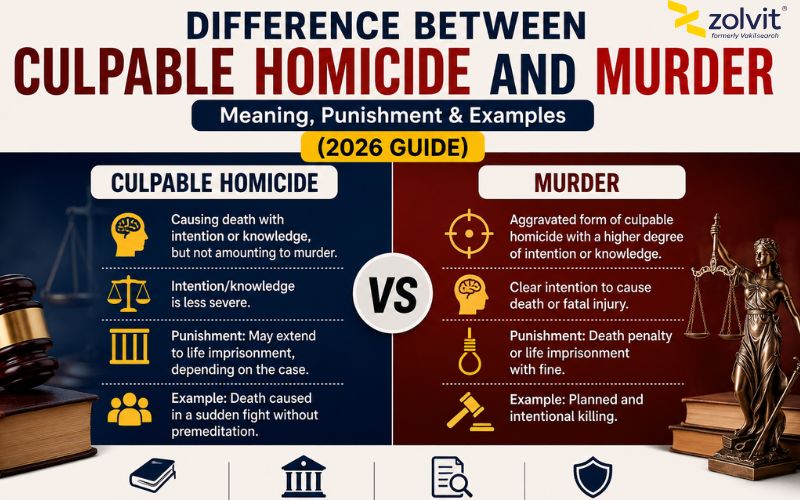
| Meaning | Causing death with intention or knowledge under circumstances that do not amount to murder | Aggravated form of culpable homicide with a higher degree of intention or knowledge |
| Intention | Intention may exist but is comparatively less severe | Clear intention to cause death or fatal injury |
| Knowledge | Knowledge that death is likely | Knowledge that death is almost certain or highly probable |
| Degree of Probability | Death is likely | Death is almost certain |
| Punishment | Varies depending on intention or knowledge; may extend to life imprisonment | Death penalty or life imprisonment with fine |
| Seriousness | Less serious | Most serious homicide offence |
| Applicable Provision (BNS) | Provisions relating to culpable homicide and culpable homicide not amounting to murder | Provision relating to murder |
| Example | Death caused during a sudden fight without premeditation | Planned and intentional killing |
Is Every Murder a Culpable Homicide?
Yes.
Every murder is legally a culpable homicide because murder is only a more serious form of culpable homicide.
However, every culpable homicide does not become murder.
Simple Flowchart
HOMICIDE
│
┌──────────────┴──────────────┐
│ │
Lawful Homicide Unlawful Homicide
│
Culpable Homicide
│
┌───────────────┴───────────────┐
│ │
Not Amounting to Murder
When Is Culpable Homicide Considered Murder?
The culpable homicide is considered to become murder when the definition of murder given by statute is satisfied in its entirety.
When There Is An Intention To Kill
Culpable homicide becomes murder when the accused is motivating him to kill another.
When There Is An Intention To Cause Serious Bodily Harm
The crime of murder is committed when the act done by the accused results in causing injuries sufficient in the normal course to lead to death.
When The Criminal Knows That The Act Will Probably Result In Death
Murder occurs when someone performs some dangerous act knowing that it would kill someone and the act is condemned legally.
Instances in which Murder is Considered Culpable Homicide
There are some factors that lower murder from a murder charge to a culpable homicide charge.
Grave Provocation
Provocation can be qualified as grave provocation if any death is caused by the individual losing his or her temper or self-control.
Exceeding the Right to Self Defense
In cases where a person acts beyond what the law prescribes for the right to self-defense, the act may be culpable homicide.
Act by a Government Employee
The exception can also apply when a government employee exceeds his or her authority while acting in good faith by virtue of the provision.
Serious Provocation Occurring During a Sudden Fight
If a serious provocation occurs while a fight is in progress and the act does not involve an element of pre-meditated killing, it will not amount to murder.
The Presence of Consent from the Victim
The offense becomes culpable homicide if the deceased consented to the death even though the victim was in the age of consent.
Culpable Homicide and Murder as per Bharatiya Nyaya Sanhita, 2023
The Bharatiya Nyaya Sanhita, 2023 (BNS) provides a clear legal framework for offences involving the unlawful causing of death. Among the most serious offences are culpable homicide and murder, which are distinguished based on factors such as intention, knowledge, and the circumstances surrounding the act.
Provisions of BNS
There are separate provisions under Bharatiya Nyaya Sanhita, 2023 dealing with the following:
- Culpable homicide
- Murder
- Punishment for murder
- Punishment for culpable homicide other than murder
The BNS is based largely on the provisions of the IPC but is a fresh law with a new numbering system and fresh drafting of laws.
Difference between the BNS and IPC
There is no change regarding the substantive difference between culpable homicide and murder. However, the BNS has introduced:
- New numbering system
- Modernized language
- Consistency in drafting
The BNS introduction is part of the criminal laws in India.
Changes Under The New Criminal Law
Some changes include:
- Introduction of Bharatiya Nyaya Sanhita, 2023 and repeal of IPC
- Renumbering of the offences and punishments
- Use of modern language in the law
- Reliance on Supreme Court’s judgment for interpretation
Landmark Supreme Court Judgments
Dattatraya v. State of Maharashtra
The Supreme Court of India, in this case, observed that in determining culpable homicide and murder, the intention of the accused, injuries sustained, and circumstances surrounding the event had to be taken into account. The Court equally reiterated that not every homicide which resulted in death would be murder.
The Court elaborated that courts must recognize the mental aspect of the crime irrespective of circumstances and, thus, ascertain whether homicide in question is murder or just culpable homicide.
Virsa Singh v. State of Punjab
This historic judgment established a classic yardstick for judging whether an injury is in itself sufficient to cause death. The Supreme Court held that if the accused has caused an injury intentionally which in itself is objectively sufficient to cause death then such injury constitutes murder.
The ruling will always remain as one of the leading and illustrative judgments in distinguishing murder from culpable homicide.
Andhra Pradesh v. Rayavarapu Punnayya case
Andhra Pradesh v. Rayavarapu Punnayya case is said to be the most prominent judgment on the subject. In this judgment, the Supreme Court clarified that culpable homicide is the genus and murder is its species.
The Court classified homicide into different types based on the degree of intention and knowledge involved. The Court explained that the distinction is one of degree and not of kind thus making this judgment a cornerstone of interpretation for offences of homicide in India.
Real-Life Scenarios of Culpable Homicide vs Murder
Road Rage
In a case of road rage, one driver knocks the other driver down during a fight. The victim suffers severe injury and dies. Depending on the circumstances, it may involve culpable homicide.
Self Defence
An owner kills a burglar while defending himself accidentally. In this case, the wrongdoing may fall under culpable homicide.
Murder by Planning
A person plans up a murder, buys a firearm, and ambushes the victim. This is obviously a case of murder.
Sudden Fight
There is a quarrel between two people and during their fights one man strikes the other which leads to his death. In this instance, there was no previous intention and hence it can be a case of culpable homicide.
Medical Negligence
A doctor does something wrong during the procedure and hence the person dies. Such cases deal with those of negligent homicide rather than culpable homicide unless intention can be proved.
Conclusion
Culpable homicide can be said to be the parent term, while murder is a specific type of this crime according to principles of law. Even if both murder and culpable homicide mean committing similar acts of killing someone, yet in the case of culpable homicide, there is no intention which differentiates it from murder and this is the most important aspect about understanding the term.
Better understanding these terms is important since it is very important for establishment of criminal liability for the commission of any offenses under Bharatiya Nyaya Sanhita, 2023.
Why to Choose Zolvit for Understanding “Difference Between Culpable Homicide and Murder”?
Understanding the difference between culpable homicide and murder can be complex because it depends on legal interpretation of intention, knowledge, and circumstances under Indian criminal law. Zolvit helps simplify these concepts by connecting you with experienced legal professionals who explain everything in a clear and practical manner.
Instead of struggling with legal jargon, you get structured guidance tailored to your situation, whether it is for learning purposes or an actual legal concern. Zolvit ensures you understand how courts interpret such cases and what factors determine the classification of an offence.
Key reasons to choose Zolvit:
- Access to Bar Council-registered and verified lawyers
- Simple explanations of complex criminal law concepts
- Assistance with legal documentation and case-related guidance
- Transparent pricing with no hidden charges
- Online consultations available from anywhere in India
- End-to-end support for legal queries and procedures
Get Expert Legal Support Today
A strong legal strategy can significantly impact the outcome of your case. Get professional assistance to understand your position, protect your rights, and navigate criminal proceedings with confidence.
CTA: Consult a Legal Expert Now
Frequently Asked Questions:
1. Can a culpable homicide case be converted into a murder case?
Yes. If new evidence establishes the intention or knowledge required for murder, a culpable homicide charge may be altered to murder during the investigation or trial.
2. How do courts decide whether an offence is murder or culpable homicide?
Courts examine the accused's intention, knowledge, nature of the injury, weapon used, manner of the act, and the surrounding circumstances to determine whether the offence qualifies as murder or culpable homicide.
3. What is the difference between intention and knowledge in criminal law?
Intention means the accused acted with the purpose of causing death or a fatal injury. Knowledge means the accused was aware that the act was likely to cause death, even if causing death was not the primary objective.
4. Can a sudden fight result in culpable homicide instead of murder?
Yes. When death occurs during a sudden fight without premeditation, in the heat of passion, and without the offender acting cruelly or taking undue advantage, the offence may be treated as culpable homicide instead of murder.
5. Why is every murder considered culpable homicide but not every culpable homicide considered murder?
Murder is a more serious form of culpable homicide. Every murder includes the essential elements of culpable homicide, but it also involves a higher degree of intention or knowledge, making it punishable as the graver offence.
